War & Revolution · February 1921 · 12 min read
The Last Mongolian Warlord: Roman von Ungern Sternberg & The Battle of Urga
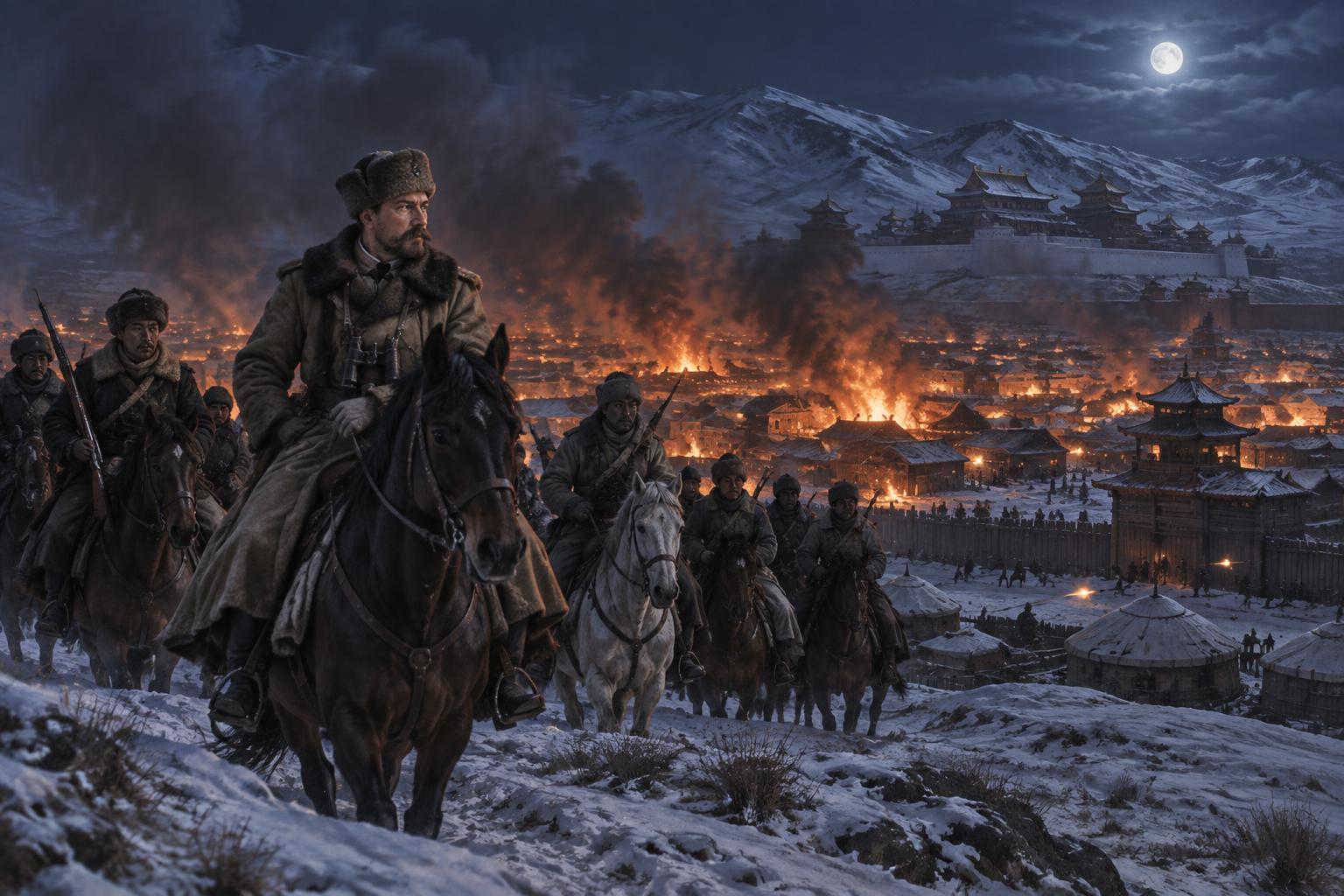
In the first days of February 1921, a defeated White Russian cavalry commander rode out of the frozen Mongolian darkness and attacked a capital held by a much larger Chinese garrison. Roman von Ungern-Sternberg called himself a monarchist. His enemies called him the Bloody Baron. History remembers him as a Mongolian warlord whose victory at the Battle of Urga restored the Bogd Khan—and whose short rule made liberation inseparable from terror.
Why the Battle of Urga Happened
The Battle of Urga grew from the collapse of two empires. After the Qing dynasty fell in 1911, Mongolia’s princes and senior lamas declared independence and enthroned the eighth Jebtsundamba Khutuktu as the Bogd Khan. The 1915 Treaty of Kyakhta recognized Mongolian autonomy under Chinese suzerainty, an unstable compromise sustained partly by the presence of imperial Russia to the north.
The Russian revolutions of 1917 removed that protection. In 1919, Chinese troops commanded by Xu Shuzheng occupied Urga, abolished Mongolia’s autonomy, disbanded its forces, and reduced the Bogd Khan to a captive sovereign. For Mongolian nobles, soldiers, and clergy, the occupation was a national humiliation. For White Russian fugitives retreating before the Red Army, Mongolia offered one of the last territories from which the Bolshevik revolution might be resisted.
Roman von Ungern-Sternberg: A Mongolian Warlord from the Russian Empire
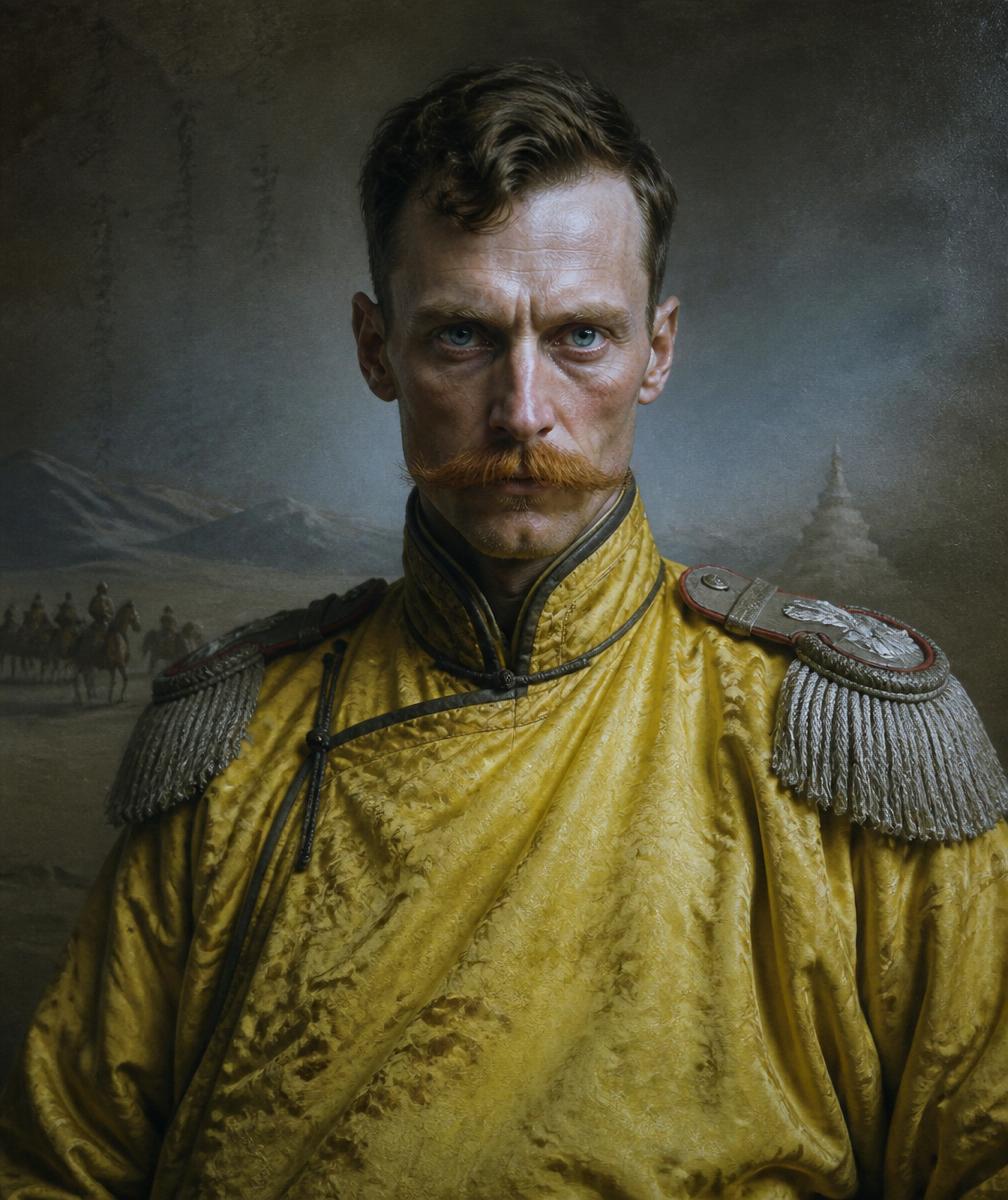
Roman Nikolai Maximilian von Ungern-Sternberg was not Mongolian by birth. Born into the Baltic German nobility and commissioned into the Imperial Russian Army, he became a decorated but notoriously undisciplined cavalry officer. War on the Transbaikal frontier transformed him into something harder to classify: part White Russian general, part independent warlord, and part religious monarchist who imagined the restoration of kings across Inner Asia.
His Asiatic Cavalry Division reflected the borderlands that produced it. Russians rode beside Buryats, Khalkha Mongols, Tibetans, Bashkirs, Tatars, and other anti-Bolshevik fighters. Allegiance could be political, religious, local, or simply a matter of survival. Ungern enforced discipline through extreme punishment and cultivated a reputation for fearlessness and cruelty. Calling him the last Mongolian warlord captures his chosen theater and political ambitions, but it should not disguise his Baltic German origins or the multinational character of his army.
Two Failed Attacks and a Winter of Preparation
Ungern entered Mongolia from Dauria in the autumn of 1920 with the Red Army closing behind him. His first attacks on Chinese-held Urga in October and November failed. The defenders had fortified the approaches, and the Asiatic Cavalry Division suffered severe losses. Ungern withdrew east toward the Kherlen River, where his force spent a brutal winter gathering horses, ammunition, food, recruits, and intelligence.
The pause changed the campaign. Mongolian opponents of the Chinese occupation could now see that Ungern’s survival depended on the same outcome they wanted: the removal of the garrison and restoration of the Bogd Khan. Local support did not make Ungern a national leader, but it gave his small army information, guides, remounts, and political legitimacy that it had lacked during the failed assaults.
The Rescue of the Bogd Khan
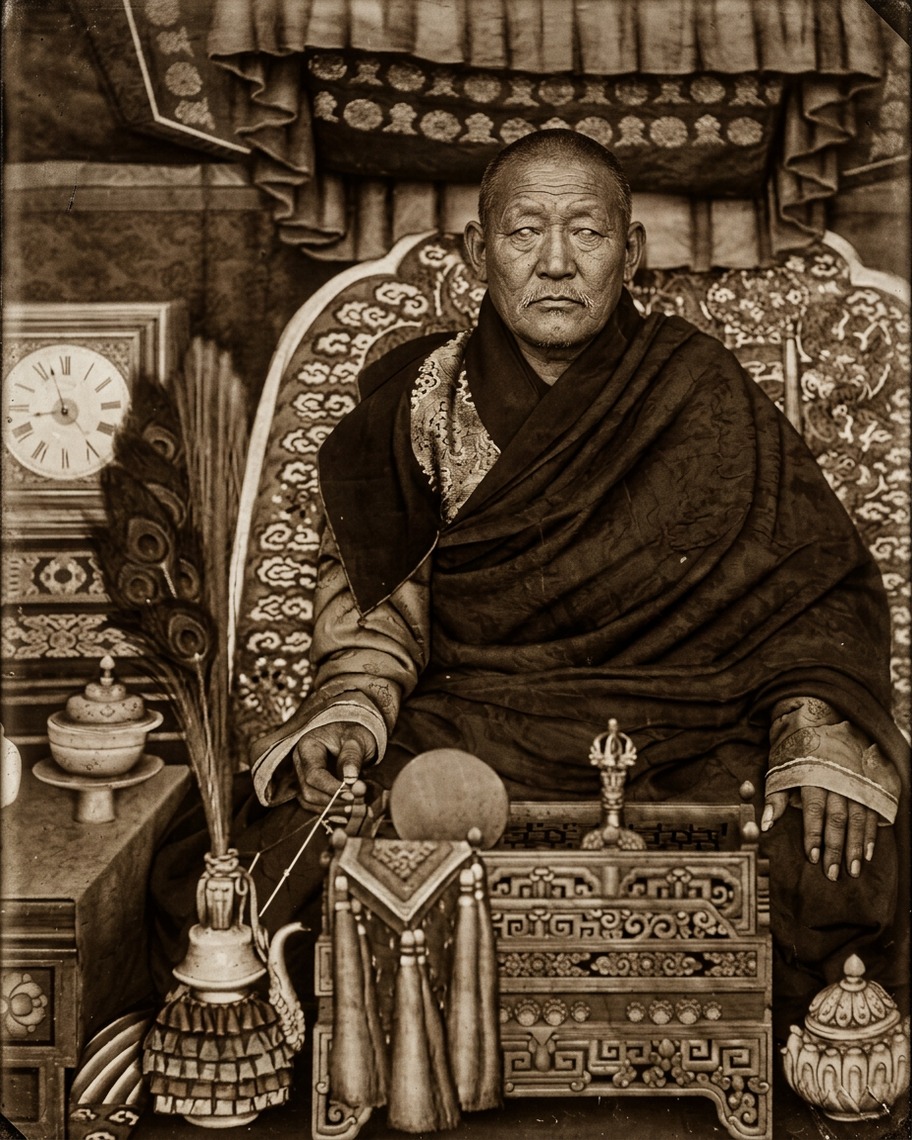
Before the main assault, a detachment loyal to Ungern removed the Bogd Khan from Chinese custody at the Green Palace south of Urga. The operation mattered far beyond the number of guards overcome. With the living Buddha of Mongolia no longer a prisoner, the Chinese occupation lost its most valuable hostage, while Ungern could present his attack as a restoration of lawful Mongolian rule rather than the invasion of another Russian exile.
Accounts of the campaign also describe signal fires or many decoy bonfires on the surrounding heights, intended to make the attackers appear more numerous. The detail is widely repeated, although the exact scale and effect are difficult to establish. What is certain is that deception, mobility, local knowledge, and the psychological force of the Bogd Khan’s rescue helped compensate for the division’s numerical weakness.
The Battle of Urga, 1–4 February 1921
The decisive Battle of Urga unfolded from 1 to 4 February 1921. Estimates vary, but Ungern’s attackers numbered roughly fifteen hundred and faced a substantially larger, better-equipped Chinese garrison. Instead of meeting that force in a conventional set-piece battle, the Asiatic Cavalry Division struck across several approaches in severe winter conditions, using mounted speed and the broken ground around the city to disrupt the defense.
Fighting reached the monastic city and the Chinese commercial quarter of Maimaicheng. The defense collapsed, and Chinese troops retreated north toward Kyakhta and south toward Manchuria. Urga had changed hands. The victory was tactically remarkable: an irregular cavalry force that had failed twice returned in midwinter and drove a superior garrison from the Mongolian capital.
Yet the phrase ‘liberation of Urga’ requires care. The battle ended Chinese military control and reopened the path to Mongolian sovereignty. It also delivered the city to an armed foreign commander whose own political project, methods, and chain of command were not subject to the restored Mongolian government.
Liberator, Conqueror, or Bloody Baron?
Ungern restored the Bogd Khan to the throne later that month and received Mongolian titles in return. In one sense, the Battle of Urga accomplished what no diplomatic protest had achieved: it destroyed the Chinese occupation and re-established a Mongolian monarchy. That outcome became part of the chain of events through which Mongolia preserved a separate political existence between Russia and China.
In another sense, Urga had exchanged one military master for another. Looting followed the capture. Ungern’s counter-intelligence apparatus hunted suspected Bolsheviks and political enemies, while the city’s Jewish community suffered a pogrom. Chinese civilians and defeated soldiers were also killed. The evidence does not permit a clean legend of national liberation. The same commander who restored the Bogd Khan presided over arbitrary executions, persecution, and terror.
This contradiction explains why historians use several vocabularies for the event. In military history it is the Battle of Urga; in narratives of statehood it can be the liberation of the capital; in studies of the Russian Civil War it is an episode of warlordism. Each name emphasizes a real part of the story, and none is complete by itself.
From Ungern’s Urga to the Mongolian Revolution
Ungern’s control lasted only months. In the spring and summer of 1921, Mongolian revolutionaries led by the Mongolian People’s Party advanced with Soviet support. Ungern marched north in a disastrous attempt to carry the war back into Siberia. His division fractured, his officers mutinied, and he was captured in August. After a public trial in Novonikolayevsk, he was executed on 15 September 1921.
Revolutionary forces entered Urga in July. The Bogd Khan remained a limited monarch until his death in 1924, when the Mongolian People’s Republic was proclaimed and Urga received the name Ulaanbaatar—‘Red Hero.’ The modern capital therefore carries layers of all these transformations: the sacred seat of the Bogd Khan, the occupied city attacked by Ungern, and the revolutionary capital that replaced his violent restoration.
What the Battle of Urga Changed
The Battle of Urga did not by itself create modern Mongolia, and Roman von Ungern-Sternberg was not its democratic founder. The independence declared in 1911, the resistance to Chinese rule, the Bogd Khan’s symbolic authority, the 1921 revolution, and Soviet power all shaped the state that followed. But the February victory broke the occupation at the exact moment when Mongolia’s future was most vulnerable.
That is why the last Mongolian warlord remains impossible to remove from the story. Ungern was an outsider who adopted Mongolia as the theater for a monarchist counterrevolution; a battlefield commander capable of defeating a stronger force; a patron of restoration who ruled through terror; and a transient figure whose actions accelerated consequences he could not control. The fires of Urga illuminated both the survival of Mongolian sovereignty and the violence from which the modern state emerged.
Historical Sources & Further Reading
- Willard Sunderland, The Baron’s Cloak: A History of the Russian Empire in War and Revolution (Cornell University Press, 2014).
- S. L. Kuzmin, The History of Baron Ungern: An Experience of Reconstruction (KMK Scientific Press, 2011).
- James Palmer, The Bloody White Baron (Faber & Faber, 2008).
- Paul du Quenoy, ‘Warlordism à la russe: Baron von Ungern-Sternberg’s Anti-Bolshevik Crusade, 1917–21,’ Revolutionary Russia 16, no. 2 (2003).
- Encyclopaedia Britannica, ‘Baron Roman von Ungern-Sternberg.’
- Treaty of Kyakhta (1915) and diplomatic correspondence concerning Outer Mongolia, 1919–1921.
- Mongolian and Soviet accounts of the 1921 Mongolian Revolution, read alongside contemporary Russian and Chinese records.