Character Dossier
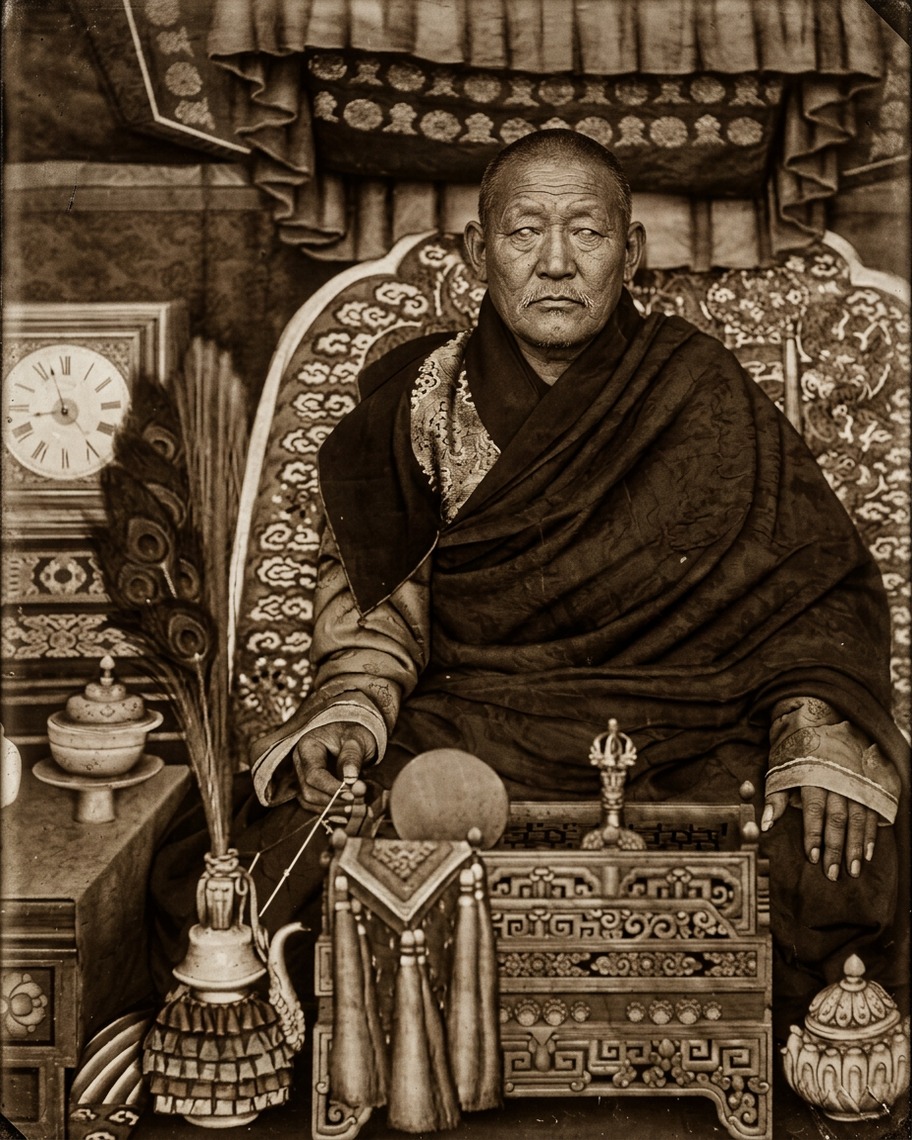
The Bogd Khan
The Living God of Mongolia · 1869 – 1924
The eighth Jebtsundamba Khutughtu, Tibetan-born and blind by the time of the revolution, was Mongolia's Buddhist head of state and its only symbol of independence. Deposed by the Chinese in 1919 and restored by Ungern in 1921, he outlived the Baron by three years.
- Born
- 1869, Tibet
- Died
- 20 May 1924, Urga
- Titles
- 8th Jebtsundamba Khutughtu · Bogd Khan of Mongolia
- Reigns
- 1911–1919 (autonomy); 1921–1924 (restored, then nominal)
Section I
Historical Biography
The eighth Jebtsundamba Khutughtu was born in Tibet in 1869 and identified as a child as the reincarnation of the Mongolian Buddhist lineage founded by Zanabazar in the seventeenth century. Brought to Urga, he became the spiritual head of Mongolian Buddhism and, in a country with no native monarchy since the Manchu conquest, the only institution capable of representing Mongolia as a whole. He was worldly, politically shrewd, fond of Western imports and mechanical novelties, and by the 1910s losing his sight to what contemporaries recorded as syphilis.
When the Qing dynasty fell in 1911, Mongolian nobles and monastic leaders declared independence and enthroned him as Bogd Khan — Holy Emperor — of an autonomous Mongolia. The arrangement was never secure: the 1915 Kyakhta Agreement between Russia, China and Mongolia reduced independence to autonomy under nominal Chinese suzerainty, and the Russian collapse of 1917 removed the counterweight that had made even that possible.
In 1919 the Beiyang general Xu Shuzheng marched troops into Urga, forced the abrogation of autonomy, and stripped the Bogd Khan of the state seals, in ceremonies designed to humiliate the Mongolian court. The Bogd Khan was placed under effective house arrest at the Green Palace on the Tuul. It was in this period that monastic networks began looking north for deliverance, and that oracles in Urga were reported to have identified the approaching Baron Ungern as an emanation of the wrathful war deity Jamsaran.
In February 1921 a raiding party of Tibetan and Buryat riders from Ungern's division extracted him from the palace and carried him to the monastery of Manzushir on the sacred mountain. Days later Urga fell, and on 22 February the Bogd Khan was re-enthroned with full ceremony — the act that gave Ungern's regime its legitimacy. That legitimacy was brief. When Soviet and Mongolian People's Party forces took Urga in July 1921, the Bogd Khan was retained as a constitutional figurehead with almost no power. He died on 20 May 1924; the Mongolian People's Republic was proclaimed months later, and the search for his next reincarnation was banned.
Section II
Historical Timeline
1911
Enthroned as Bogd Khan
The Qing collapse allows Mongolian nobles and lamas to declare independence and install the Jebtsundamba Khutughtu as Holy Emperor.
1915
The Kyakhta Agreement
Russia and China reduce Mongolian independence to autonomy under Chinese suzerainty.
November 1919
Autonomy abolished
Xu Shuzheng's Beiyang troops force the abrogation of autonomy and confiscate the state seals; the Bogd Khan is confined at the Green Palace.
1920
Couriers to the north
Monastic and noble networks open secret channels toward Ungern's advancing division while the Mongolian People's Party forms in the underground.
1 February 1921
The rescue
Picked riders breach the Green Palace and carry the blind monarch over Bogd Khan Uul to sanctuary at Manzushir monastery.
22 February 1921
Re-enthronement
Restored in Urga with full ceremony; Ungern is granted the title of Khan and the rank of a Mongolian prince.
July 1921
The revolution arrives
Soviet and Mongolian People's Party forces enter Urga; the Bogd Khan is retained as a figurehead of a constitutional monarchy.
20 May 1924
Death
Dies in Urga. The Mongolian People's Republic is declared later that year and further reincarnations are prohibited.
Section III
Appearance in the Novel
The Bogd Khan is the prize every faction in the novel is fighting over: the one man whose blessing can convert force into legitimacy.
Key chapters of the 30-chapter blueprint
- Chapter 3 — The Shadow of the Beiyang: stripped of the sacred seals by Xu Shuzheng.
- Chapter 5 — The Sacred Prisoner: house arrest at the Green Palace, secret couriers, and the oracle declaring Ungern an emanation of Jamsaran.
- Chapter 11 — The Rescue of the Holy King: the daylight raid and the flight over the sacred mountain.
- Chapter 13 — The Restored Throne: the re-enthronement, the bestowal of titles, and a cryptic blessing on Zanzer.
- Chapter 17 — The Steppe Court: astrologers at court give the Baron 130 days.
Narrative dynamic
He is written as neither saint nor puppet — a blind, exhausted, extremely astute politician who understands that the man who liberated him is also the man most likely to destroy his country, and who plays for time accordingly.
Section IV
Bibliography & Sources
- Urgunge Onon & Derrick Pritchatt, Asia's First Modern Revolution: Mongolia Proclaims Its Independence in 1911 (Brill, 1989).
- Thomas E. Ewing, Between the Hammer and the Anvil? Chinese and Russian Policies in Outer Mongolia, 1911–1921 (Indiana University, 1980).
- C. R. Bawden, The Modern History of Mongolia (Kegan Paul, 1968).
- Alan J. K. Sanders, Historical Dictionary of Mongolia — entries on the Jebtsundamba Khutughtu and the Bogd Khaan Palace Museum.
- Baabar (B. Batbayar), History of Mongolia (White Horse Press, 1999).
Section V