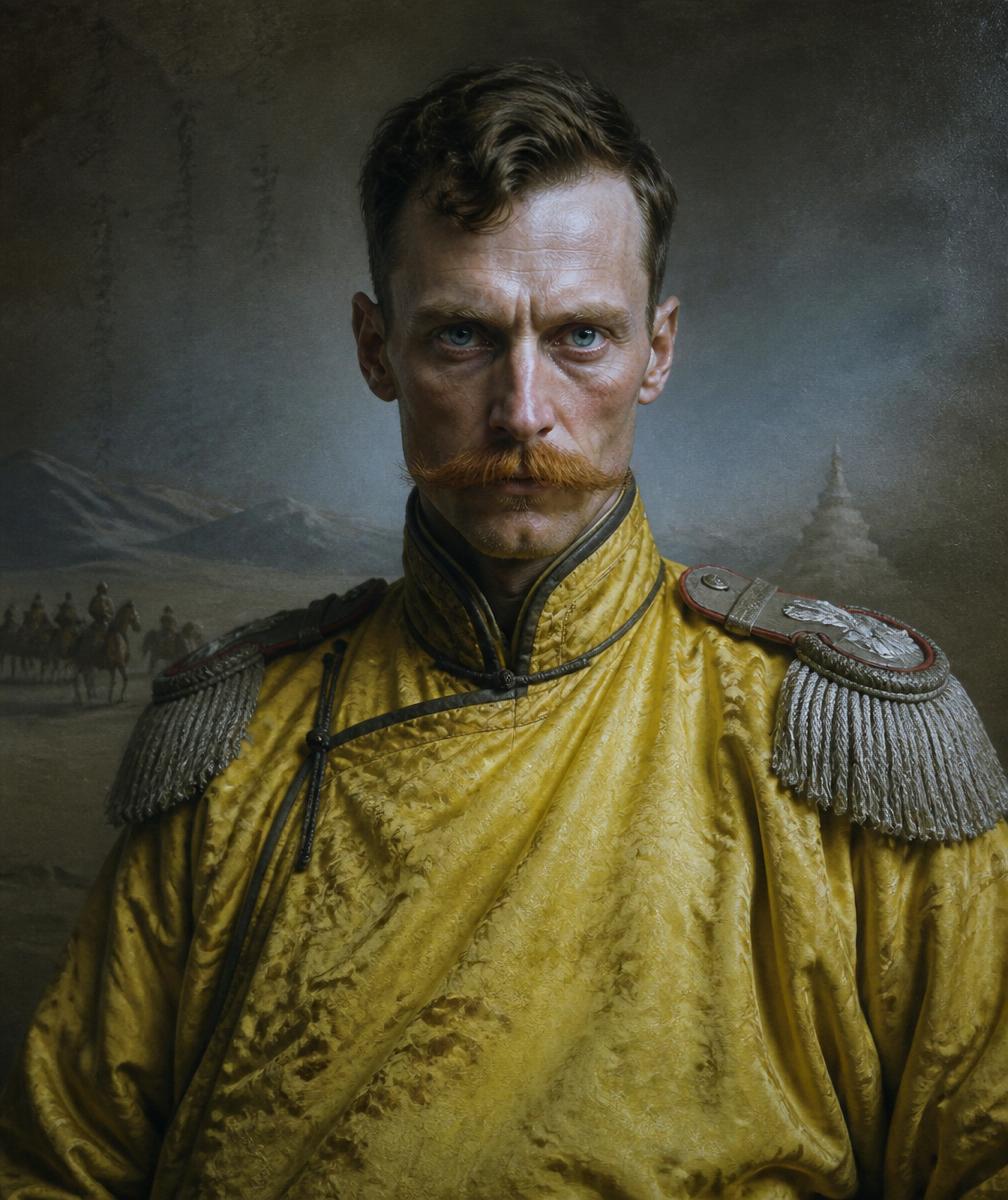
Character Dossier
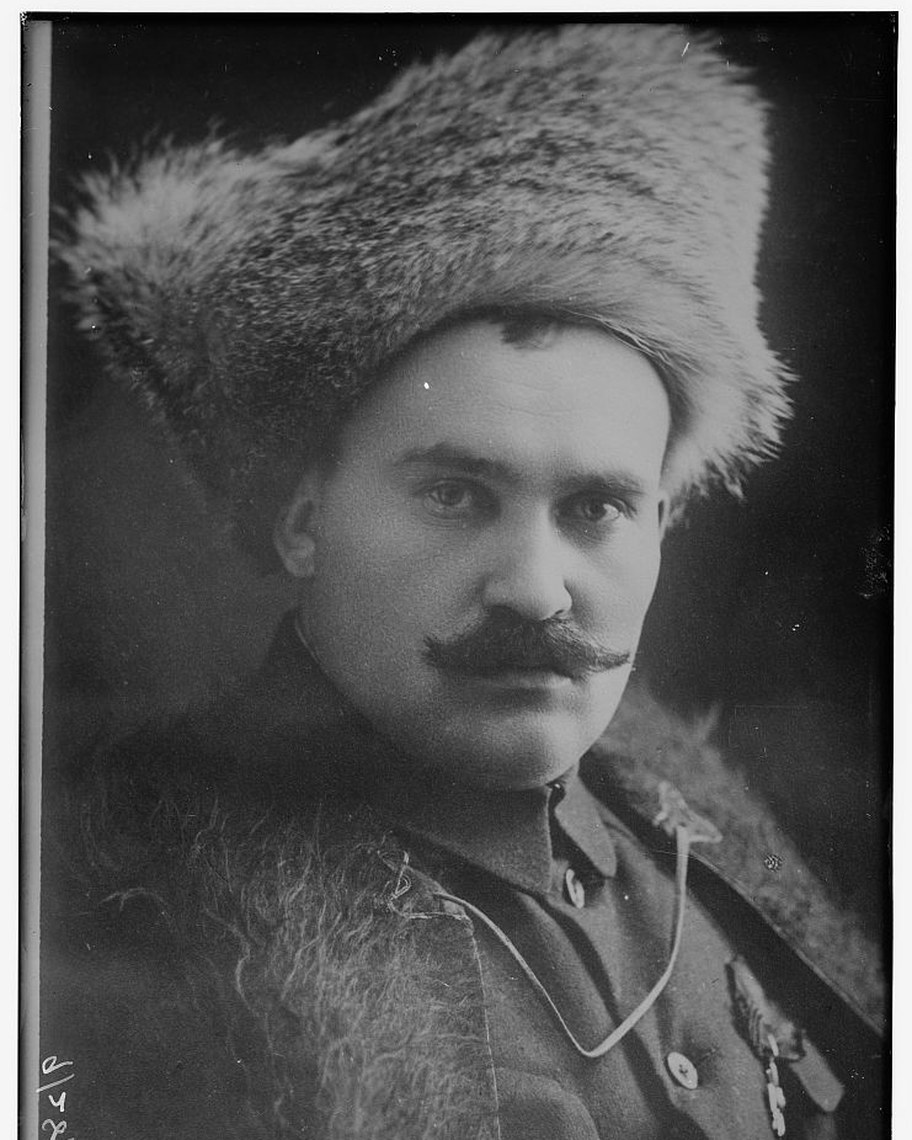
Baron Roman von Ungern-Sternberg
The Mad Baron · 1885 – 1921
A Baltic-German cavalry officer who believed himself the instrument of a Buddhist prophecy and conquered Mongolia with four thousand riders. Within six months of taking Urga he had restored a living god to his throne and drowned the city in terror.
- Born
- 29 December 1885, Graz, Austria
- Died
- 15 September 1921, Novonikolayevsk (Novosibirsk)
- Affiliation
- Asiatic Cavalry Division · White movement
- Rank / Title
- Lieutenant General; Khan of Mongolia (1921)
Founder Access
A Cold Siberian Noir 3-Season Web-Only Series
White Khan chronicles the explosive clash between the Mad Baron Roman von Ungern-Sternberg and Jewish mining engineer Israel Eli Zanzer across the lawless frontiers of 1920s Mongolia.
Join the Inner Circle for early-access screening windows, production dispatches, and an exclusive founder discount on season-by-season subscriptions before Season 1 premieres.
No spam. Direct dispatches, premiere alerts, and subscriber pricing only.
Section I
Historical Biography
Baron Roman Nikolai Maximilian von Ungern-Sternberg was born in Graz in December 1885 into a Baltic-German noble family and raised in Reval — modern Tallinn — inside the Russian Empire's Estonian provinces. Expelled from the Naval Cadet Corps for indiscipline, he finished at the Pavlovsk Military School in 1908 and requested posting to the furthest edge of the empire: the Transbaikal and Amur Cossack hosts, where he learned Mongolian, absorbed Tibetan Buddhism, and formed the conviction that the nomadic monarchies of Asia were the last uncorrupted societies on earth.
The First World War made his reputation. Serving in Galicia and the Carpathians with the Nerchinsk Cossacks under Baron Wrangel, he was decorated with the Order of St George and wounded repeatedly; Wrangel's memoirs describe him as an outstanding fighting officer and a hopeless one in garrison — chronically drunk, insubordinate, indifferent to comfort or property. The February and October revolutions of 1917 dissolved the army around him. With Grigory Semyonov, a fellow Transbaikal officer, he began raising irregular units in the Far East and by 1918 commanded the garrison at Dauria, a border station that became notorious for summary executions of prisoners taken from the Trans-Siberian line.
The execution of Nicholas II and his family in July 1918 turned Ungern's politics into eschatology. He came to see the revolution not as a Russian crisis but as the collapse of hierarchy itself, and monarchy — Romanov, Manchu or Mongol — as the only defence against it. In the autumn of 1920, with Kolchak dead and the White cause finished in Siberia, he broke from Semyonov, took his Asiatic Cavalry Division of roughly a few thousand Russians, Buryats, Mongols, Tatars, Tibetans and Japanese volunteers south across the frontier and attacked Chinese-occupied Urga. Two assaults in October and November 1920 failed with heavy losses. He wintered on the Kherlen, rebuilt, and in early February 1921 took the city.
His rule lasted about four months. He restored the Bogd Khan to the throne on 22 February 1921, received the title of Khan and the rank of a Mongolian prince, and simultaneously licensed a regime of torture, arbitrary hanging and a pogrom against Urga's Russian-Jewish population carried out largely by his counter-intelligence chief Leonid Sipailov. In May 1921 he invaded Soviet Siberia; the Fifth Red Army broke his division at Troitskosavsk in June. His surviving officers mutinied in August, his Mongol escort bound him and left him for a Red patrol, and after a six-hour show trial in Novonikolayevsk on 15 September 1921 he was shot the same night, aged thirty-five.
Section II
Historical Timeline
July 1918
The Romanovs are executed
News of the Ipatiev House killings reaches the Transbaikal. Ungern, then commanding at Dauria, begins describing the war as a religious rather than political struggle.
1918 – 1919
Dauria and the Semyonov years
Commands the Asiatic Cavalry Division under Ataman Semyonov's Japanese-backed regime, controlling a stretch of the Trans-Siberian and the Manchurian border.
October 1920
Break with Semyonov, march into Mongolia
With Chita collapsing, Ungern crosses the frontier with his division and demands the Chinese garrison surrender Urga.
Oct – Nov 1920
The failed assaults on Urga
Two attacks on the Chinese-held capital are beaten back by machine-gun fire in extreme cold. The division retreats east to winter on the Kherlen river.
1 – 4 February 1921
The signal fires and the capture of Urga
Bonfires lit across the slopes of Bogd Khan Uul convince the garrison it is massively outnumbered. A raiding party extracts the Bogd Khan from house arrest; the city falls days later.
22 February 1921
The Bogd Khan restored
Ungern re-enthrones the Jebtsundamba Khutughtu, is granted the title of Khan and the hereditary rank of a Mongolian prince, and adopts the yellow deel.
Spring 1921
The terror in Urga
Sipailov's counter-intelligence conducts mass killings, including the pogrom against the city's Jewish community; Mongolian and Russian allies begin to defect.
May – June 1921
The invasion of Soviet Siberia
The northern campaign crosses the frontier and is shattered by the Fifth Red Army's artillery, armoured cars and aircraft around Troitskosavsk.
August 1921
Mutiny and capture
Officers assassinate General Rezukhin and fire on Ungern's tent. His Mongol riders bind him and abandon him; a Red scout patrol takes him prisoner on 20 August.
15 September 1921
Trial and execution
Tried in a Novonikolayevsk theatre by a revolutionary tribunal with Emelyan Yaroslavsky prosecuting. Sentenced to death and shot that night.
Section III
Appearance in the Novel
Ungern is one of the two poles of White Khan. The novel follows him from the Siberian taiga to the firing squad, refusing both hagiography and caricature: a tactically brilliant, genuinely devout, genuinely murderous man who mistook his own paranoia for prophecy.
Key chapters of the 30-chapter blueprint
- Chapter 1 — The Eclipse of the Crown: receives news of the Romanov execution in the taiga and forms the Asiatic Cavalry Division.
- Chapter 2 — The Atamansha of Chita: requisitions the Mongol'Or mine at gunpoint to launder Kolchak's imperial bullion into clean corporate gold.
- Chapters 4–5 — Parts from Semyonov at Dauria, marches south, and opens secret courier channels to the captive Bogd Khan.
- Chapters 7, 9 — Lights the signal fires on Bogd Khan Uul; the first assault on Urga fails in forty-below cold.
- Chapters 11–13 — The raid on the Green Palace, the storming of Urga, and the re-enthronement that makes him Khan.
- Chapters 14, 17, 21 — Places Zanzer under personal protection while the court astrologers give him 130 days to live and the terror spreads.
- Chapters 23–27 — The northern crusade, the defeat at Troitskosavsk, the mutiny, and the show trial where he refuses to give up Zanzer's identity.
Narrative dynamic
His relationship with Israel-Eli Zanzer is the novel's engine: the Baron needs the engineer's ledgers, smelters and credit lines to finance a holy war, and the engineer needs the Baron's protection to keep his community alive. Each man knows exactly what the other is worth, and exactly what the arrangement will cost him.
Section IV
Bibliography & Sources
- James Palmer, The Bloody White Baron: The Extraordinary Story of the Russian Nobleman Who Became the Last Khan of Mongolia (Faber, 2008).
- Willard Sunderland, The Baron's Cloak: A History of the Russian Empire in War and Revolution (Cornell University Press, 2014).
- Leonid Yuzefovich, Samoderzhets pustyni / Horsemen of the Sands (Moscow, 1993; English edition 2018).
- S. L. Kuzmin (ed.), Baron Ungern in Documents and Memoirs (Moscow: KMK, 2004) — trial transcripts, orders and interrogation records.
- Ferdinand Ossendowski, Beasts, Men and Gods (New York, 1922) — eyewitness but heavily embroidered; read against the archival record.
- Pyotr Wrangel, Always with Honour (memoirs) — on Ungern's wartime service in the Nerchinsk Cossack Regiment.
- Jamie Bisher, White Terror: Cossack Warlords of the Trans-Siberian (Routledge, 2005).
Section V