Biography · 1885 – 1921 · 9 min read
Who Was Baron Ungern-Sternberg?
He was thirty-five years old when he was shot, and he had ruled a country for four months. Almost everything written about Baron Roman von Ungern-Sternberg since has been an argument about what he actually was: a monarchist crusader, a Buddhist millenarian, a warlord, or a symptom of the disintegration of the Russian Empire on its furthest frontier.
A Baltic Noble on the Wrong Edge of an Empire
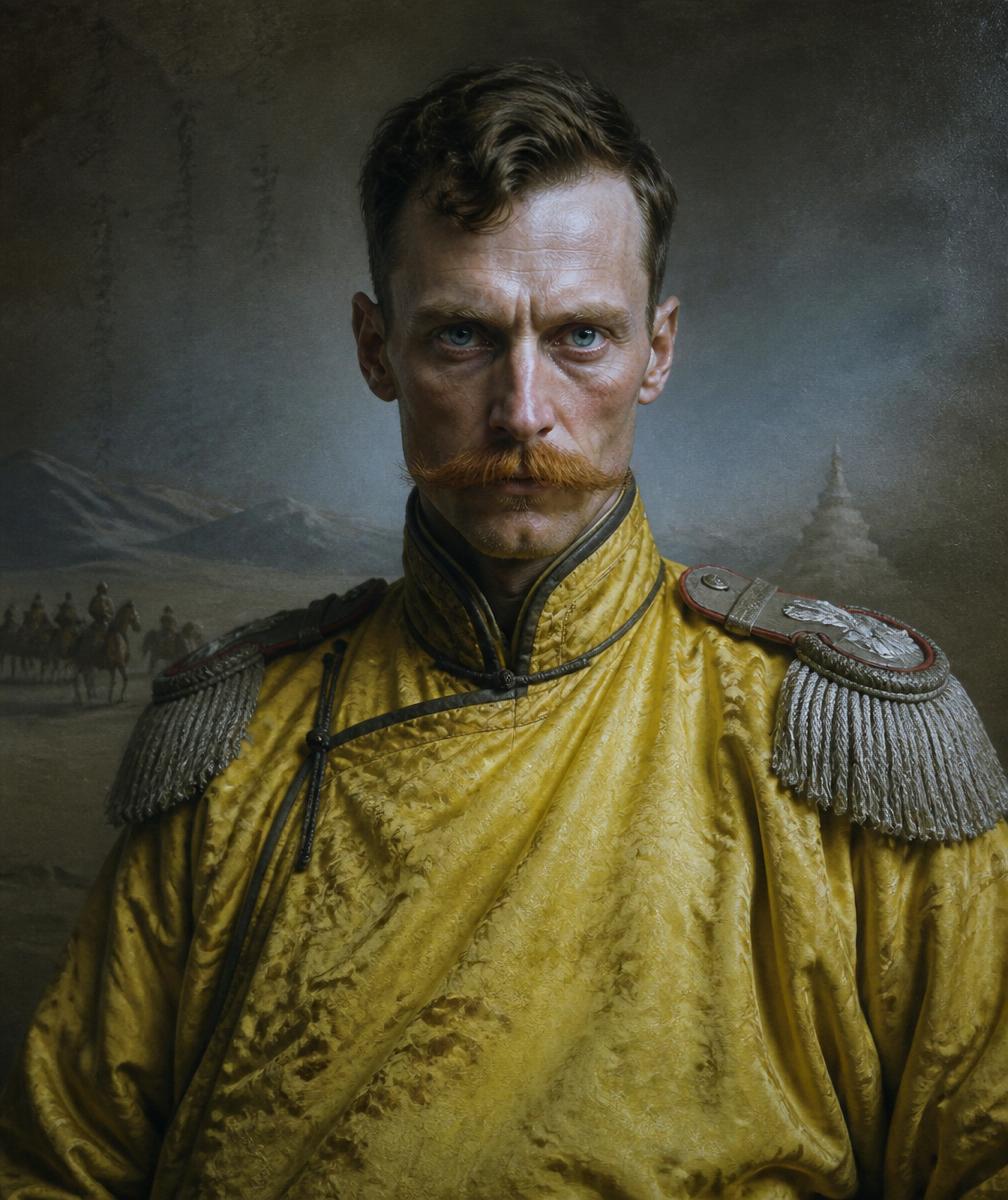
Roman Nikolai Maximilian von Ungern-Sternberg was born in Graz in December 1885 and raised in Reval — modern Tallinn — in the Estonian provinces of the Russian Empire. His family belonged to the Baltic German nobility, a caste that supplied the Romanovs with generals and administrators for two centuries while remaining culturally apart from the Russia it served. That double identity mattered: Ungern grew up loyal to a dynasty rather than to a nation, which is the only frame in which his later politics make sense.
Expelled from the Naval Cadet Corps for indiscipline, he graduated from the Pavlovsk Military School in 1908 and requested the furthest posting available — the Transbaikal frontier, then the Amur Cossack host. On the Transbaikal frontier he learned Mongolian, absorbed a working knowledge of Tibetan Buddhism from lamas at frontier monasteries, and formed the conviction that the nomadic monarchies of Inner Asia were the last uncorrupted societies left on earth. Officers who served with him in those years describe a man already indifferent to money, comfort, promotion and personal safety.
The Great War and the Making of a Reputation
The First World War made Ungern's name. Serving in Galicia and the Carpathians with the Nerchinsk Cossacks under Baron Wrangel, he was decorated with the Order of St George and wounded repeatedly. Wrangel's memoirs are the most quoted assessment of him: an outstanding fighting officer and a hopeless garrison one — chronically drunk, insubordinate, contemptuous of property and paperwork alike.
The revolutions of 1917 dissolved the army around him. With Grigory Semyonov, a fellow Transbaikal officer, he began raising irregular formations in the Far East, and by 1918 commanded the garrison at Dauria — a border station on the Trans-Siberian line that became notorious for the summary execution of prisoners pulled off passing trains. Dauria is where the Ungern of legend begins: a commander who no longer distinguished between war, policing and punishment.
The Regicide That Turned Politics into Prophecy
The execution of Nicholas II and his family in July 1918 converted Ungern's monarchism into something closer to eschatology. He came to describe the revolution not as a Russian crisis but as the collapse of hierarchy itself — and monarchy, whether Romanov, Manchu or Mongol, as the only defence against it. From 1919 onward his correspondence reads less like a general's and more like a prophet's.
The Asian Cavalry Division
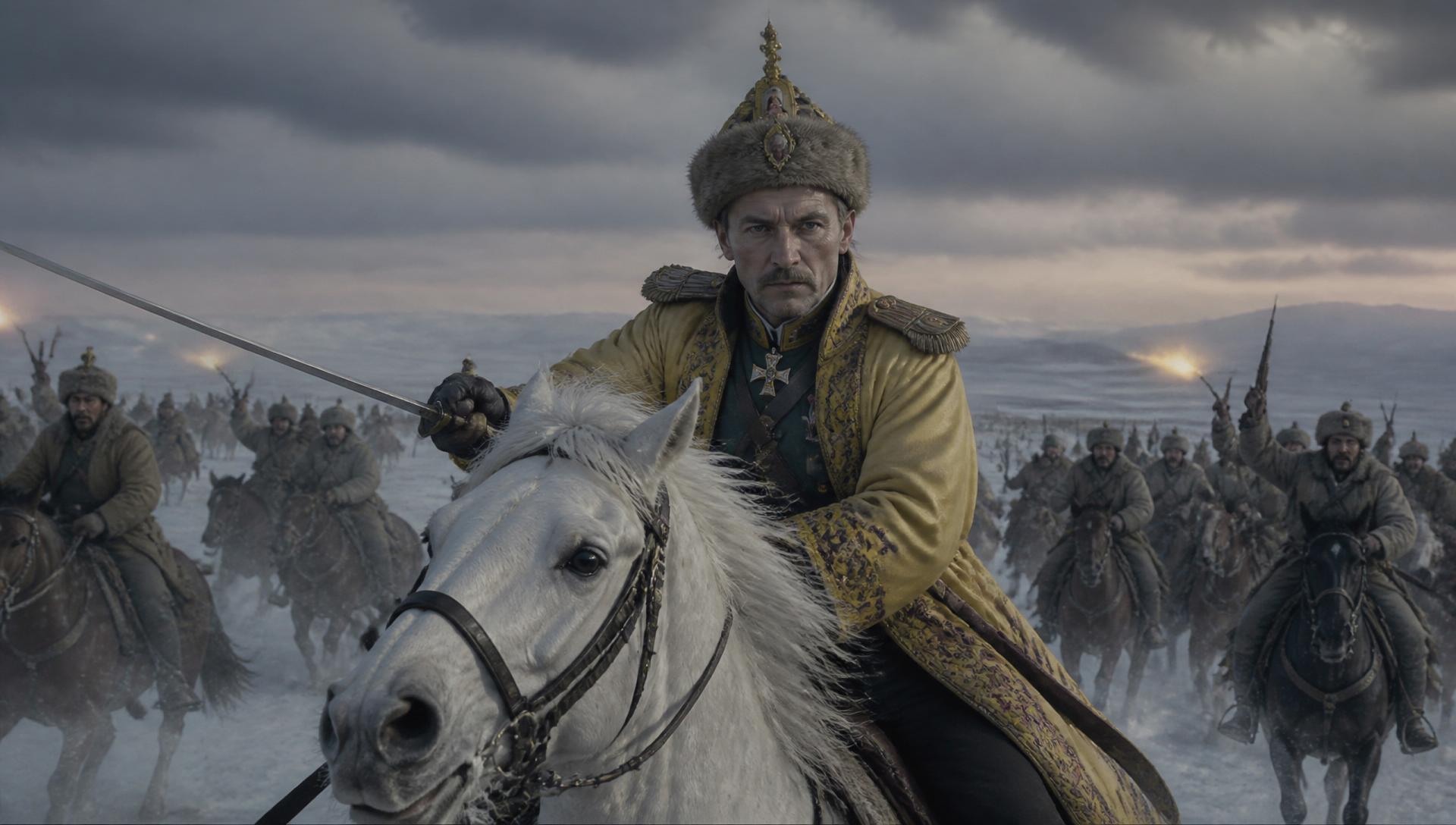
In autumn 1920, with Admiral Kolchak executed and the White cause finished in Siberia, Ungern broke from Semyonov and took his Asian Cavalry Division south across the frontier. The division was never large — a few thousand riders — and it was polyglot to an extraordinary degree: Russian officers, Buryats, Khalkha Mongols, Tatars, Bashkirs, Tibetans sent by the Dalai Lama's court, and Japanese volunteers. Discipline was maintained by terror; Ungern's own punishment book prescribed beatings, exposure on rooftops in winter, and hanging.
Two assaults on Chinese-occupied Urga in October and November 1920 failed with heavy losses. He wintered on the Kherlen river, rebuilt the division, ran a remount and requisition network across eastern Mongolia — and, critically, secured a supply of hard currency. A cavalry division in the Gobi does not run on ideology. It runs on remounts, rifles, cartridges, silver and salt bought from merchants who will not accept the paper money of a collapsed empire.
Where the Money Came From
This is the question that conventional accounts of Ungern skip, and the question at the centre of White Khan. Between the failed assaults of November 1920 and the successful storm of Urga in February 1921, a broken and starving division was re-equipped. Somebody paid for it in metal.
The book's narrative theory follows the metal rather than the manifesto: that part of the Romanov gold reserve seized at Kazan in 1918 and carried east by Admiral Kolchak's train — the portion that never reached Vladivostok, never reached Japan, and has never been fully accounted for — was moved south into Mongolia and washed through the books of the Mongol'Or mining concession, the country's principal gold operation. The mechanism was corporate rather than criminal in appearance: concession payrolls, assay records, ore-return declarations and Kyakhta trade credits, handled by a Jewish mining engineer and finance specialist, Israel-Eli Zanzer, who understood that bullion with a Romanov stamp is evidence, while bullion declared as Mongolian placer output is simply production.
Four Months as Khan
Urga fell in early February 1921. Ungern restored the Bogd Khan to the throne on 22 February, received the title of Khan and the rank of a Mongolian prince, and simultaneously licensed a regime of torture, arbitrary hanging and a pogrom against the city's Russian-Jewish population, executed largely by his counter-intelligence chief Leonid Sipailov. The Urga occupation is where the liberator and the executioner occupy the same man in the same week.
In May 1921 he invaded Soviet Siberia with the intention of raising a general anti-Bolshevik rising. The Fifth Red Army broke his division near Troitskosavsk in June. His surviving officers mutinied in August; his Mongol escort bound him and left him for a Red patrol. After a six-hour show trial in Novonikolayevsk on 15 September 1921 he was shot the same night.
What He Left Behind
Mongolia's revolutionary government dates its own founding to the months in which Ungern was destroyed, which is why he remains a fixed reference point in Mongolian national history rather than a footnote in Russian. And the ledgers of the concession he leaned on outlived him — which is the thread the novel pulls.
Historical Sources & Further Reading
- Willard Sunderland, The Baron's Cloak: A History of the Russian Empire in War and Revolution (Cornell University Press, 2014).
- James Palmer, The Bloody White Baron (Faber & Faber, 2008).
- Baron Wrangel, Always with Honour — memoirs covering the Nerchinsk Cossacks, 1914–1917.
- Ferdinand Ossendowski, Beasts, Men and Gods (1922) — eyewitness, to be read against the archival record.
- Transcript of the trial of R. F. von Ungern-Sternberg, Novonikolayevsk, 15 September 1921 (Soviet state records).
- British Foreign Office consular correspondence, Peking and Kyakhta files, 1920–1922.