Character Dossier
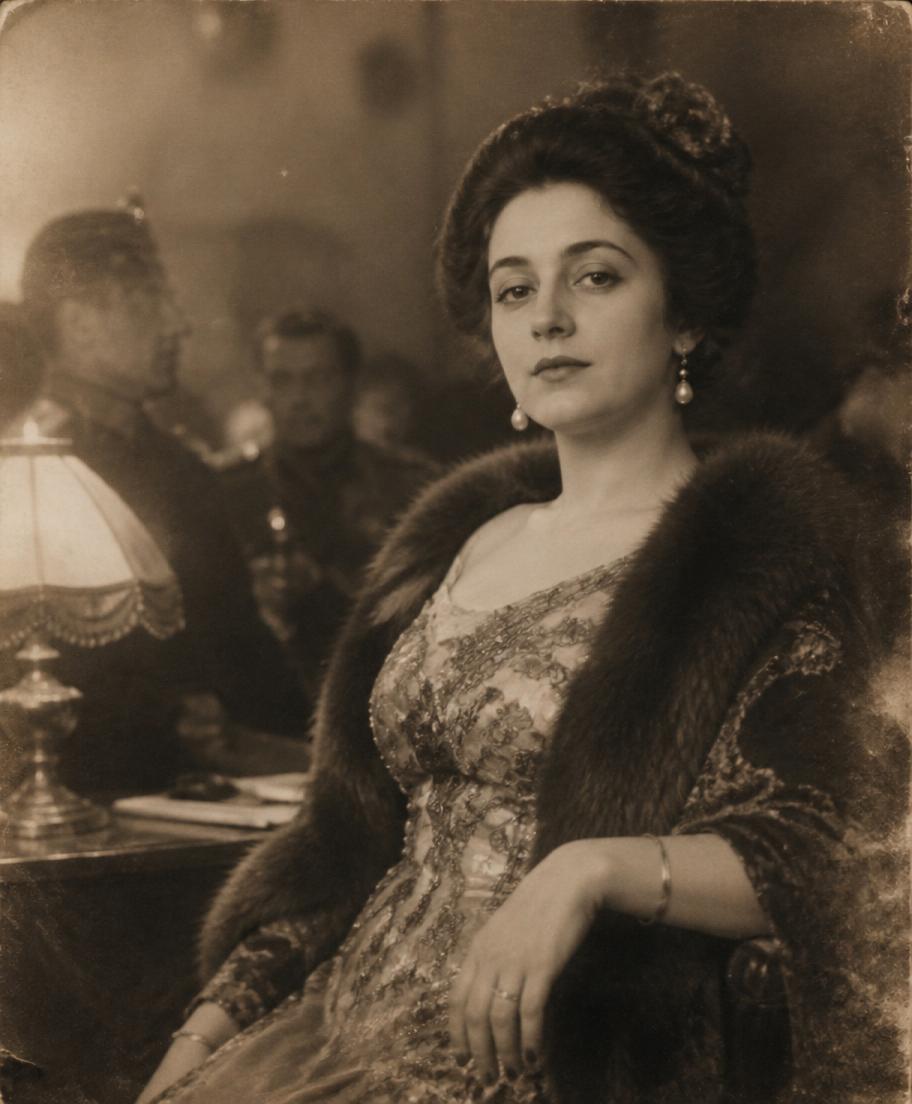
Masha Sharaban
The Atamansha of Chita · fl. 1918 – 1921
A cabaret singer who became Ataman Semyonov's consort and, by many accounts, the real power broker of his Chita court. Petitioners, contracts and pardons went through her long before they reached the Ataman.
- Active
- Chita, Transbaikal, c. 1918–1920
- Known as
- Masha Sharaban · 'the Atamansha'
- Affiliation
- Court of Ataman Grigory Semyonov
- Fate
- Emigrated east with the Semyonov circle; poorly documented
Section I
Historical Biography
Chita between 1918 and 1920 was a warlord capital: an Ataman with Japanese subsidies, armoured trains on the Trans-Siberian, gambling houses, requisitioned bullion and a cabaret culture that ran all night while the executions ran all day. Out of that world came the woman remembered as Masha Sharaban — a singer of the officers' clubs whose stage name derived from the popular Russian song 'Sharaban', and who became the consort of Ataman Grigory Semyonov.
Émigré memoirists and Soviet-era accounts agree on her nickname, 'the Atamansha', and on the substance behind it: that access to Semyonov ran through her, that commercial concessions and personal pardons could be bought at her table, and that she kept her own following among the officers of the garrison. Semyonov's regime had no functioning bureaucracy, so patronage of exactly this kind was the administration.
Beyond that the record is thin and contested. Names, dates and biographical details differ between sources; several accounts conflate her with other women of Semyonov's household, and the Soviet literature had an obvious interest in painting the Ataman's court as a brothel with a treasury attached. Historians treat the colourful anecdotes with caution while accepting the basic outline: an entertainer who converted proximity to a warlord into real influence over money and lives.
Her later trajectory is undocumented in any reliable source. Semyonov's circle scattered into Manchuria and Japanese-occupied China after Chita fell in late 1920, and the women of that court largely vanish from the archive at the same moment. White Khan treats her as a historically grounded figure whose interior life is necessarily reconstructed.
Section II
Historical Timeline
1918
The Chita court forms
Semyonov establishes his Japanese-backed regime in the Transbaikal capital; its social life runs through the cabarets and officers' clubs.
1918 – 1919
The Atamansha
Becomes Semyonov's consort and a recognised channel for petitions, concessions and pardons within the Ataman's patronage system.
1919 – 1920
The gold years
Chita becomes a clearing house for requisitioned bullion and imperial reserves moving east along the Trans-Siberian.
Late 1920
The fall of Chita
The Far Eastern Republic and Red partisans force Semyonov out; his court disperses into Manchuria. The record on her ends here.
Section III
Appearance in the Novel
In White Khan the Atamansha is the reader's way into the money — the character who explains, without a single battle scene, how a holy war actually gets financed.
Key chapters of the 30-chapter blueprint
- Chapter 2 — The Atamansha of Chita & The Laundering Deal: introduced in the decadent warlord capital as Ungern moves on Mongol'Or.
- Chapter 4 — The March of the Four Thousand: audits the Baron as Semyonov and Ungern part ways at Dauria.
- Chapter 18 — The Old Marshal's Move: the exiled Ataman's circle feels Zhang Zuolin's financial pressure.
Narrative dynamic
She is the one person in the novel who is entirely unimpressed by prophecy. Where Ungern sees destiny and Zanzer sees logistics, she sees a balance sheet — and she is usually right first.
Section IV
Bibliography & Sources
- Jamie Bisher, White Terror: Cossack Warlords of the Trans-Siberian (Routledge, 2005) — on the Chita regime and its patronage networks.
- Grigory Semyonov, O sebe: vospominaniya, mysli i vyvody (memoirs, Harbin, 1938).
- Canfield F. Smith, Vladivostok Under Red and White Rule (University of Washington Press, 1975).
- Russian émigré memoir literature on Chita 1918–1920; note that details concerning the 'Atamansha' vary sharply between accounts.
- Note on the record: this dossier flags where documentation is weak rather than presenting anecdote as established fact.
Section V