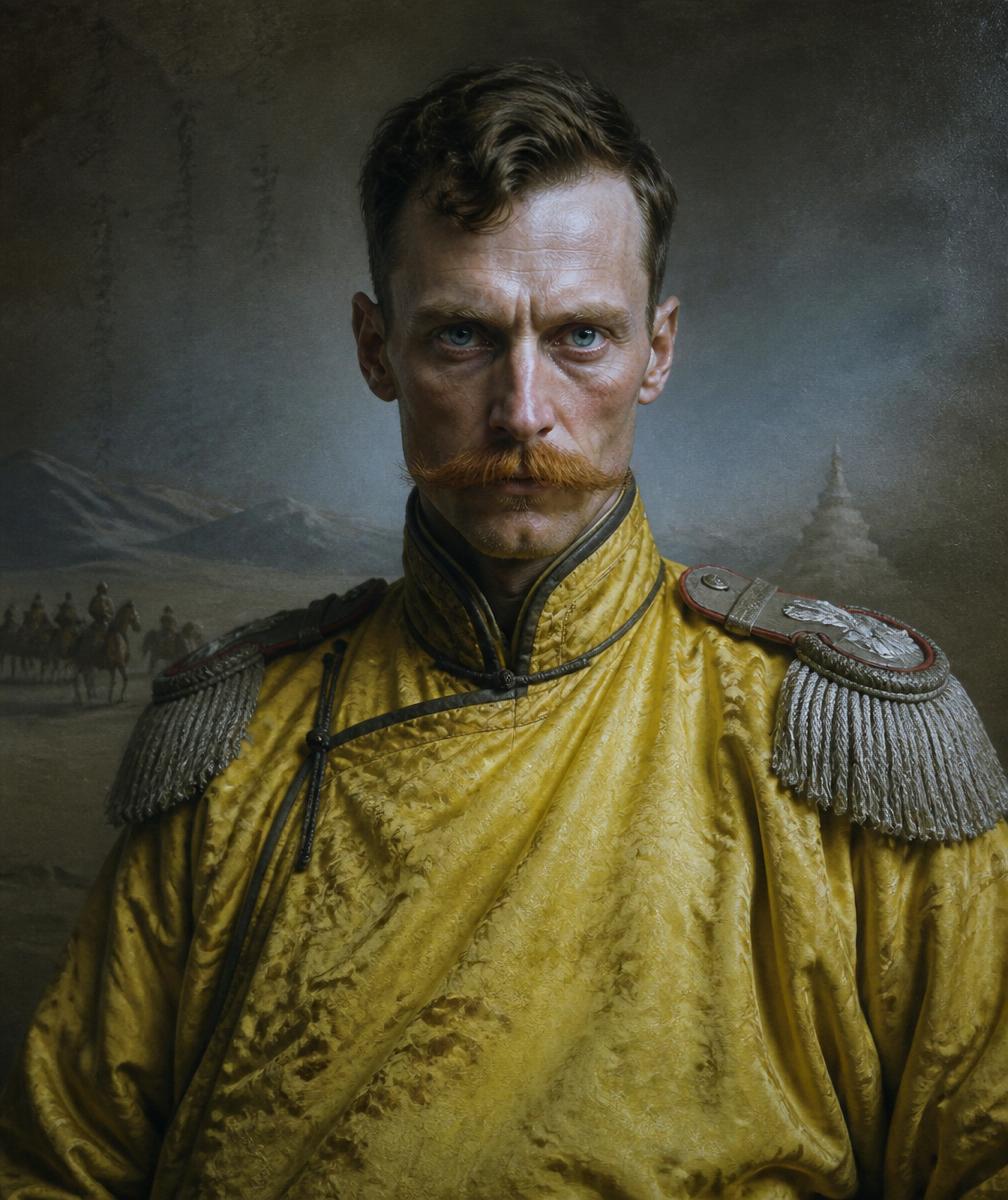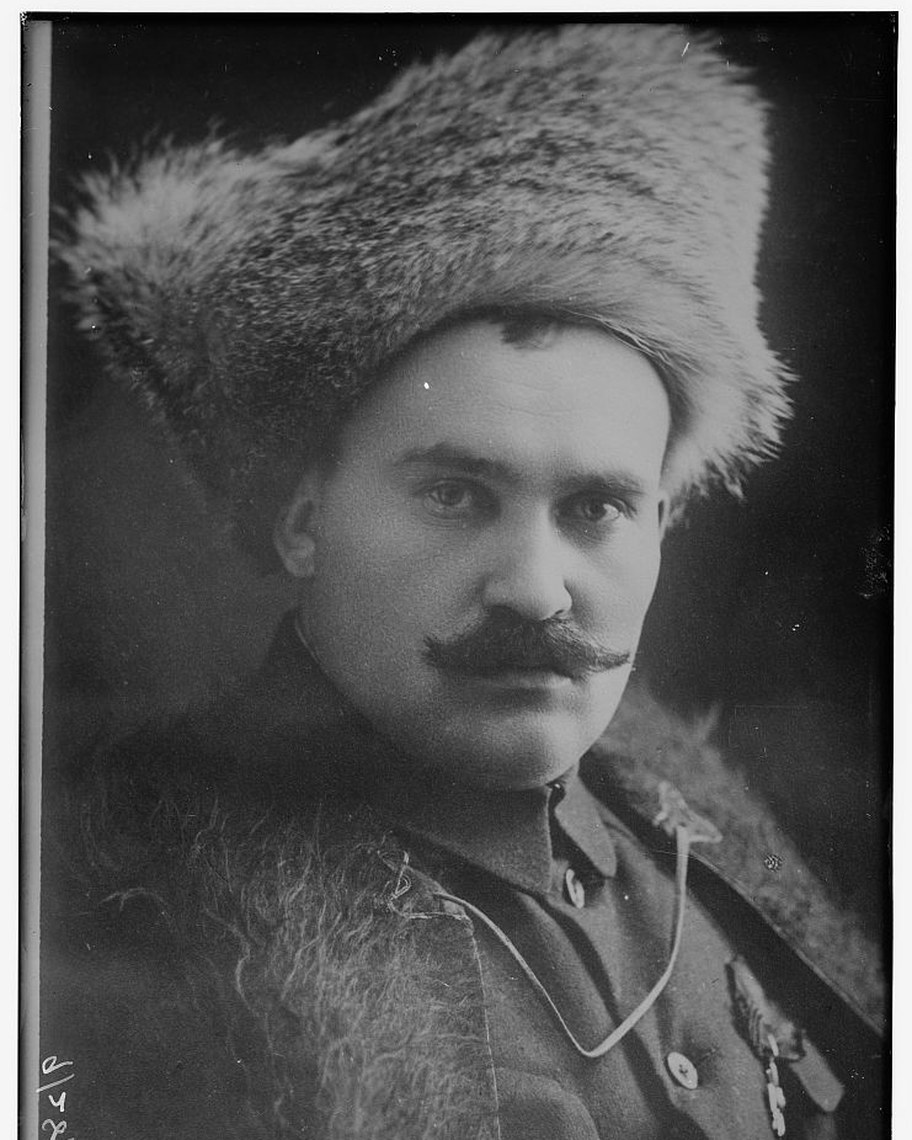
Character Dossier
Ataman Grigory Semyonov
Warlord of the Transbaikal · 1890 – 1946
The Japanese-backed Cossack ataman who ruled Chita and the Trans-Siberian with armoured trains and firing squads, and who first gave Ungern a command. Captured by Soviet forces in Manchuria in 1945, he was hanged in Moscow the following year.
- Born
- 13 September 1890, Kuranzha, Transbaikal
- Died
- 30 August 1946, Moscow (executed)
- Affiliation
- Transbaikal Cossack Host · Japanese-supported White regime
- Title
- Ataman; Lieutenant General
Section I
Historical Biography
Grigory Mikhailovich Semyonov was born in 1890 in the Transbaikal to a Cossack family of partly Buryat descent, spoke Mongolian and Buryat from childhood, and was commissioned into the Transbaikal Cossack Host. He served in the First World War with distinction and was sent back east in 1917 by the Provisional Government to raise volunteer units among the Buryats and Mongols — an assignment that put him in position, when the Bolsheviks seized power, to convert a recruiting mission into a private army.
From late 1917 he built the Special Manchurian Detachment on the Chinese Eastern Railway, funded principally by Japan, which saw in him a usable client on the Siberian frontier. By 1918 he controlled Chita and long stretches of the Trans-Siberian, running his territory through armoured trains, seizures of freight and cash, and the notorious killing stations at Adrianovka and Dauria, where the garrison commander was Baron Ungern. Admiral Kolchak, the nominal White supreme ruler, spent much of 1919 unable to control him; in January 1920 the collapsing Kolchak government transferred authority in the Far East to Semyonov anyway.
The relationship with Ungern deteriorated through 1920. Ungern regarded Semyonov as corrupt and unserious about monarchy; Semyonov regarded Ungern as uncontrollable. When Chita's position became untenable, the Asiatic Cavalry Division separated and rode south into Mongolia while Semyonov withdrew east. His regime ended in late 1920 with the advance of the Far Eastern Republic and Red partisans, and he left for Manchuria.
He spent twenty-five years in exile in Japanese-controlled Manchuria and Japan, associated with émigré fascist and anti-Soviet organisations and with Japanese military intelligence. When the Red Army entered Manchuria in August 1945 he was arrested at his home near Dairen, tried in Moscow in a public trial, convicted of terrorism, espionage and armed struggle against the Soviet state, and hanged on 30 August 1946.
Section II
Historical Timeline
1917
Sent east to recruit
Raises Buryat and Mongol volunteer units in the Transbaikal, then refuses to recognise the Bolshevik seizure of power.
1918
The Special Manchurian Detachment
Builds a Japanese-financed force on the Chinese Eastern Railway and takes control of Chita and the Transbaikal railway corridor.
1918 – 1919
Terror on the line
Armoured trains, requisitions and mass executions at Adrianovka and Dauria; Ungern commands the Dauria garrison and the Asiatic Cavalry Division.
January 1920
Successor to Kolchak in the east
The collapsing Omsk government hands Semyonov authority over the Russian Far East weeks before Kolchak is shot.
Autumn 1920
The split with Ungern
The Asiatic Cavalry Division breaks away at Dauria and rides south into Mongolia.
Late 1920
Chita falls
Semyonov flees to Manchuria as the Far Eastern Republic consolidates the Transbaikal.
1921 – 1945
Exile
Lives under Japanese protection in Manchuria, involved with émigré anti-Soviet organisations and Japanese intelligence.
30 August 1946
Executed
Arrested by SMERSH in 1945, tried publicly in Moscow and hanged.
Section III
Appearance in the Novel
Semyonov is the world Ungern comes from and rejects: the same violence without the metaphysics, the same gold without the crusade.
Key chapters of the 30-chapter blueprint
- Chapter 2 — The Atamansha of Chita: the decadent warlord capital, the laundering deal, and the requisition of Mongol'Or.
- Chapter 4 — The March of the Four Thousand: the parting at Dauria and the fall of Chita.
- Chapter 18 — The Old Marshal's Move: 'the Ataman in exile' as Zhang Zuolin chokes the credit lines.
Narrative dynamic
Their split is ideological before it is tactical. Semyonov wants a state he can sell; Ungern wants a kingdom he can consecrate. Zanzer, caught between them, is the only man who can keep both financed at once — for a while.
Section IV
Bibliography & Sources
- Jamie Bisher, White Terror: Cossack Warlords of the Trans-Siberian (Routledge, 2005).
- Grigory Semyonov, O sebe: vospominaniya, mysli i vyvody (Harbin, 1938).
- Paul Dotsenko, The Struggle for a Democracy in Siberia, 1917–1920 (Hoover Institution Press, 1983).
- Canfield F. Smith, Vladivostok Under Red and White Rule (University of Washington Press, 1975).
- Soviet transcript of the 1946 Military Collegium trial of Semyonov and associates (published in Pravda, 27–30 August 1946).
Section V