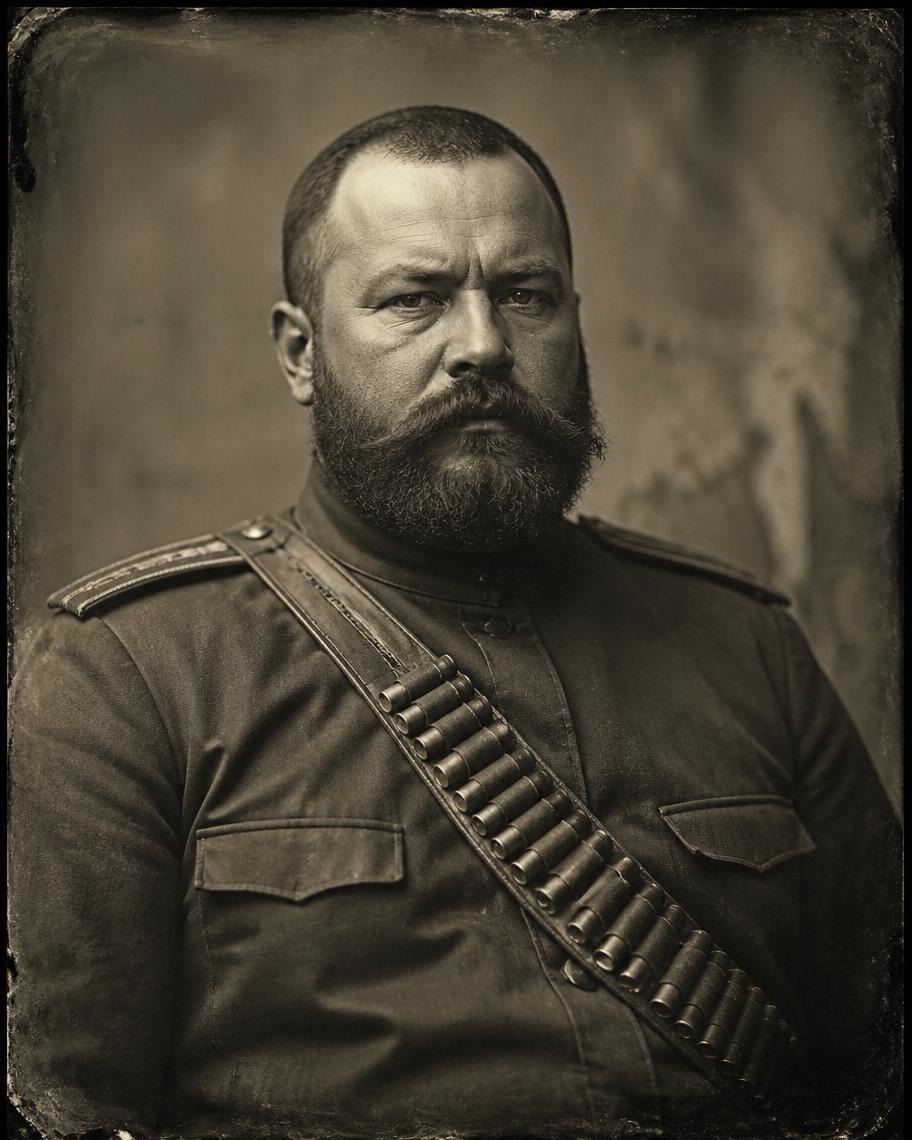
Character Dossier
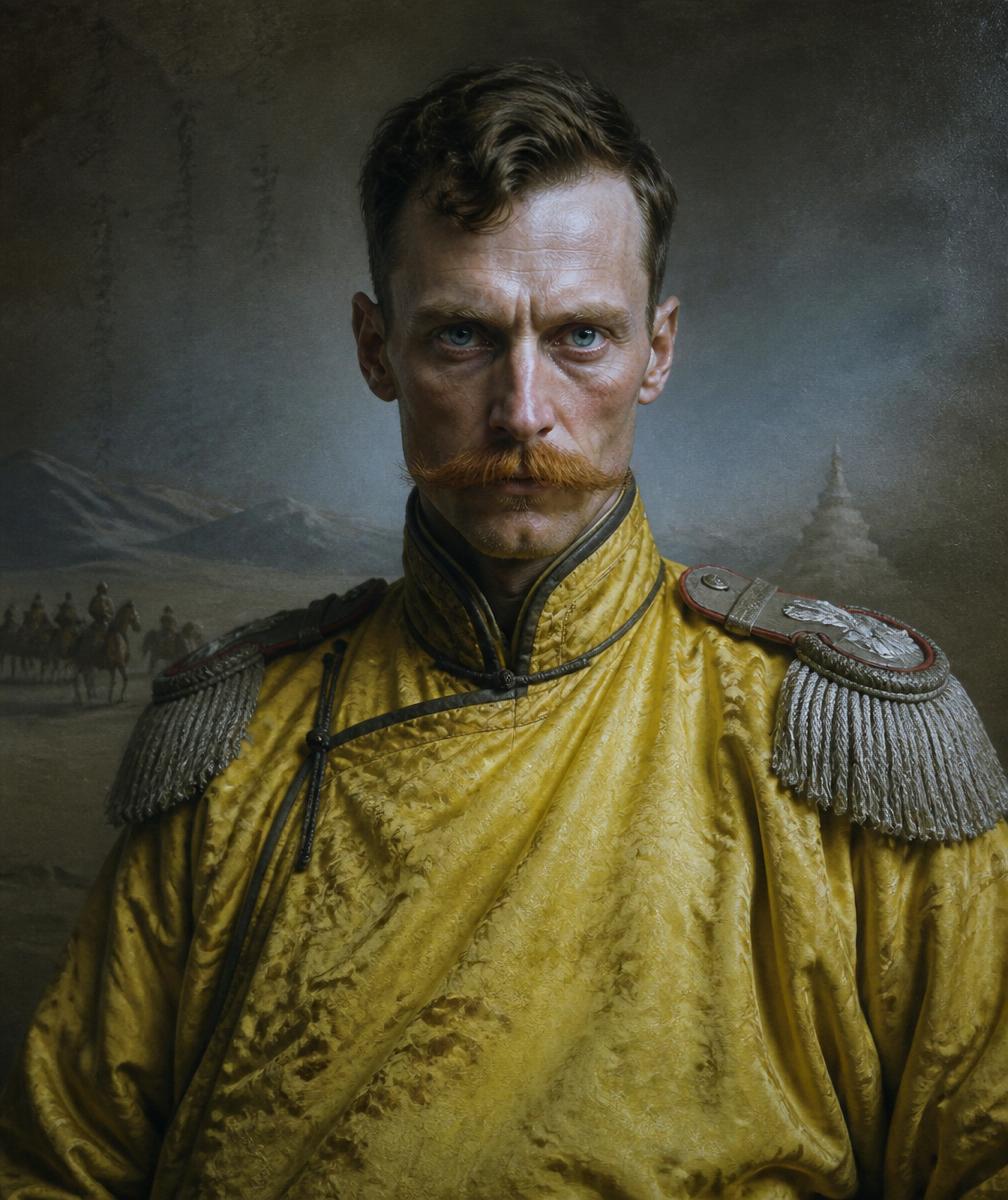
Colonel Leonid Sipailov
The Executioner of Urga · c. 1880 – 1921
Ungern's counter-intelligence chief and commandant of Urga, remembered by every surviving witness as the most frightening man in Mongolia. He ran the interrogations, the strangling squads and the pogrom, and his own fate is uncertain.
- Born
- c. 1880, Russian Empire
- Died
- 1921 (circumstances disputed)
- Affiliation
- Asiatic Cavalry Division — counter-intelligence
- Post
- Commandant of Urga; head of the Baron's secret police
Section I
Historical Biography
Leonid Sipailov emerged from the wreckage of the imperial army as one of the men the civil war promoted: an obscure officer of no distinguished service who discovered that in a regime without courts, the person who controls interrogation controls everything. He attached himself to Ungern in the Transbaikal and by February 1921 was commandant of captured Urga and head of the Asiatic Division's counter-intelligence.
Every surviving account of Ungern's Urga — Ossendowski's, the staff physician Riabukhin's, the émigré depositions collected afterwards — converges on Sipailov as its central horror. He is described as physically unsettling, with a nervous tic and a habit of talking gently while ordering killings, and as a man who preferred strangulation because it saved ammunition. His squads operated at night, took people from their homes on denunciation or suspicion, and killed them outside the city.
It was Sipailov who executed the practical machinery of the anti-Jewish pogrom that followed the capture of Urga, and who extended the killings to Russian civilians, refugees, suspected Bolshevik sympathisers and, eventually, to officers of the division itself. He also enriched himself systematically from the property of the dead. Ungern used him deliberately — Sipailov did what the Baron's own officers would not — and by the summer of 1921 several of those officers regarded removing the commandant as a precondition for removing the Baron.
His end is not securely documented. Sipailov was not with the division when it disintegrated on the Selenga, and the accounts diverge: some hold that he was caught and killed in 1921 while trying to escape through Mongolia, others that he was executed after falling into Soviet or Mongolian hands. What is certain is that he does not appear anywhere in the record after 1921. Historians of the period treat the various death stories as unverified.
Section II
Historical Timeline
1918 – 1920
Attaches to the Division
Rises within Ungern's forces in the Transbaikal through the counter-intelligence apparatus rather than field command.
February 1921
Commandant of Urga
Appointed to run the captured capital and the Baron's secret police.
February – March 1921
The pogrom
Directs the killings of Urga's Jewish residents and of Russian civilians denounced as Bolshevik sympathisers.
Spring 1921
The terror widens
Night arrests, strangulation squads and confiscation of the property of the dead; officers of the division begin to fear him.
Summer 1921
Separated from the Division
Remains behind as the northern campaign departs; the shield over Urga's survivors reaches breaking point.
1921
Disappears from the record
Reported killed in several conflicting accounts. No verified account of his death exists.
Section III
Appearance in the Novel
Sipailov is the antagonist Zanzer actually has to outwit. The Baron can be bargained with; the commandant cannot.
Key chapters of the 30-chapter blueprint
- Chapter 15 — The Secret Minyan of Urga: his secret police expand their purges as the hidden sanctuary is built.
- Chapter 21 — The Reign of Terror: his men copy the roll from the concession loft.
- Chapter 28 — The Exodus across the Gobi: the shadow the caravans are running from as the capital collapses.
Narrative dynamic
He is written strictly from the testimony — no invented atrocities are needed. His function in the plot is to make Zanzer's protection worthless the moment the Baron's attention moves north.
Section IV
Bibliography & Sources
- Ferdinand Ossendowski, Beasts, Men and Gods (1922) — extended eyewitness description of Sipailov in Urga.
- N. M. Ribo (Riabukhin), The Story of Baron Ungern Told by His Staff Physician (Hoover Institution Archives).
- S. L. Kuzmin (ed.), Baron Ungern in Documents and Memoirs (Moscow, 2004) — depositions on the Urga killings.
- James Palmer, The Bloody White Baron (Faber, 2008).
- Émigré press reporting on the Urga pogrom, Harbin and Shanghai, 1921–1922.
Section V