Law & Ideology · 15 September 1921 · 8 min read
The Ungern Trial — The Ideological Duel of Monarchy vs Bolshevik Revolution
The Soviet state did not need a trial to shoot Baron Ungern-Sternberg. It needed one to explain him. What it got instead was a defendant who agreed with the charges, disputed the premises, and turned the proceeding into the only formal debate the two ideologies ever held in the same room.
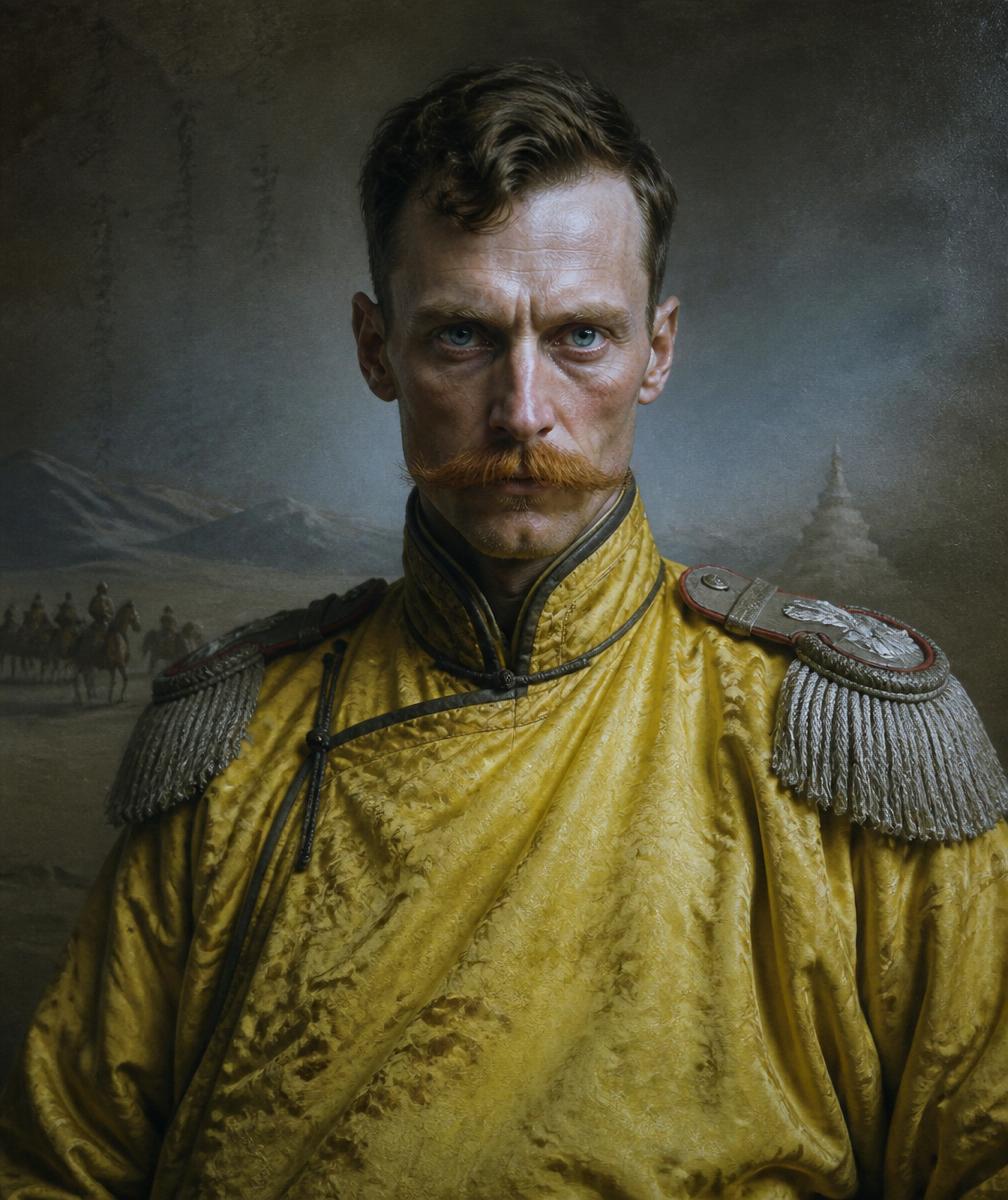
Capture
After the defeat at Troitskosavsk in June 1921 the Asian Cavalry Division disintegrated politically before it disintegrated militarily. Ungern's intention to ride west into Tibet or Xinjiang broke the officers' remaining willingness to follow; Rezukhin was murdered by his own men in August, and a conspiracy against Ungern followed within days.
He escaped one assassination attempt and was taken by a Mongol detachment of his own command, bound, and left for a Red Army patrol under Shchetinkin. He was moved by rail to Novonikolayevsk — modern Novosibirsk — where the trial was prepared in a matter of weeks with Moscow's direct involvement.
A Trial Designed as Theatre
The venue was a theatre, deliberately. The proceeding was public, reported at length in the Soviet press, and prosecuted by Yemelyan Yaroslavsky, a senior party figure rather than a career lawyer. The verdict was decided in advance; Lenin is recorded in Politburo discussion as endorsing a public trial followed by execution.
The Charges
Three counts framed the case: acting as an agent of Japanese imperialism against Soviet Russia; armed struggle to restore the Romanov dynasty, specifically the plan to place Grand Duke Michael on a restored throne; and mass terror and atrocity — the killings at Dauria, the sack of Urga, and the pogrom of February 1921.
Ungern's response to the first charge was contemptuous denial: he had taken Japanese money and volunteers but served no foreign state. To the second he pleaded guilty with enthusiasm. To the third he neither denied the acts nor accepted the framing, treating executions as an ordinary instrument of restoring order.
The Ideological Duel
The trial's interest lies in the exchange underneath the charges. Yaroslavsky's case was materialist and historical: the Baron was the terminal expression of a dying landowning class, his mysticism a symptom, his cruelty the honest face of the old regime. He wanted Ungern to represent a system.
Ungern refused the role of representative and claimed the role of prophet. His answers describe the revolution not as a class conflict but as the collapse of hierarchy itself, an event in religious rather than economic time. Monarchy — Romanov, Manchu, Mongol, it barely mattered — was for him the human reflection of a cosmic order, and Bolshevism the deliberate destruction of that order. Asked about the future, he offered the observation that the Bolsheviks were building something disciplined and hierarchical themselves, and that history would tell which of them had understood the century.
Asked whether he expected mercy, he said he did not, and that a man who had fought for a thousand-year order should not haggle over a few years of life. This is why the transcript still circulates: for one afternoon, the two most absolute political positions of the twentieth century argued with each other in public and neither conceded a point.
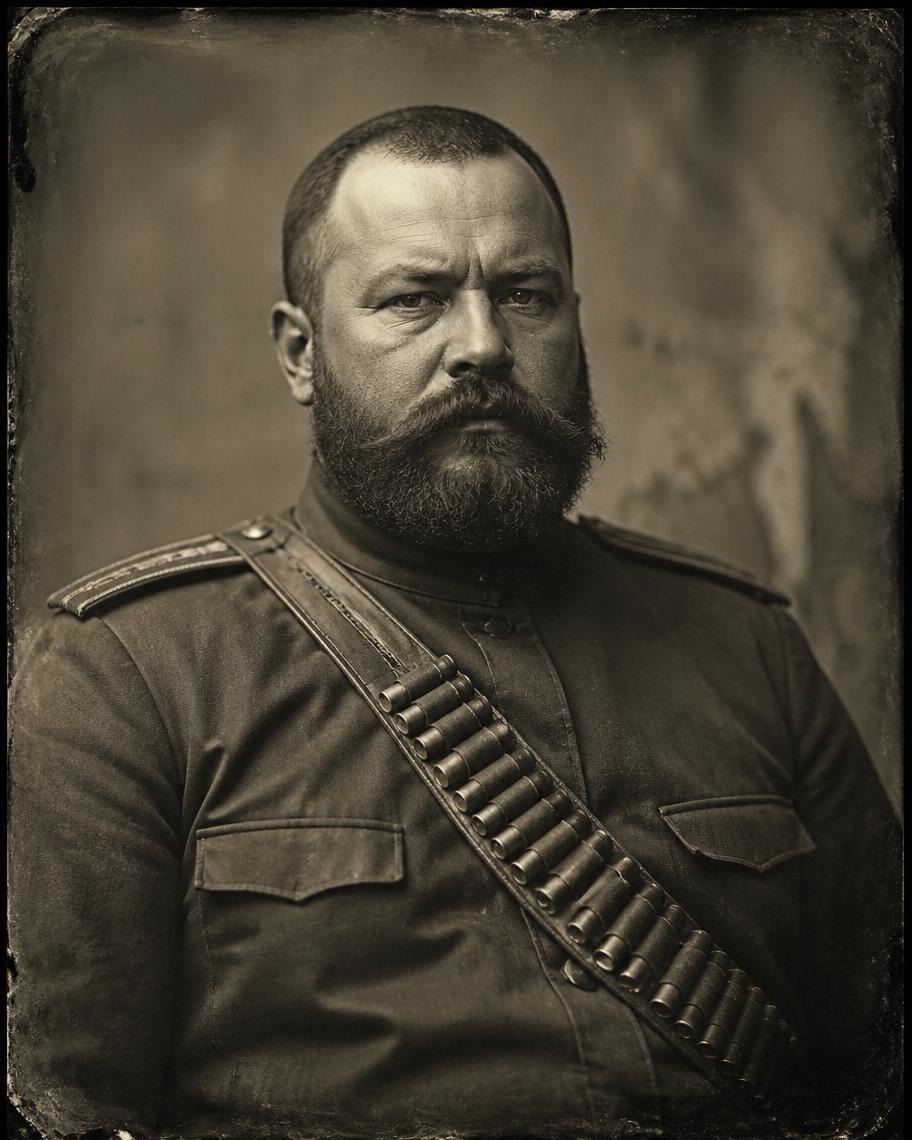
What the Trial Did Not Examine
For all its length on ideology, the trial was almost silent on logistics. It did not seriously ask how a division destroyed in November 1920 was re-equipped by February 1921, or where the metal came from that paid the Kherlen winter's suppliers. The prosecution's interest was in what Ungern believed, not in what he banked.
White Khan treats that silence as the story's opening. The novel's reconstruction — Kolchak bullion moved south across the Transbaikal frontier and laundered as Mongolian production through the Mongol'Or concession's ledgers under Israel-Eli Zanzer — answers a question the court never asked, and explains why the concession's 1920–21 records did not survive the year in usable form.
Execution and Afterlife
The court deliberated briefly and sentenced him to be shot. The sentence was carried out the same night, 15 September 1921. He was thirty-five. He has never been rehabilitated under Russian law, and successive petitions to that effect have been refused — an unusually durable verdict for a Soviet-era court.
Historical Sources & Further Reading
- Transcript of the trial of R. F. von Ungern-Sternberg, Novonikolayevsk, 15 September 1921 (Soviet state records).
- Soviet press coverage of the trial, Sovetskaya Sibir, September 1921.
- Politburo correspondence regarding the disposition of Ungern, summer 1921.
- Willard Sunderland, The Baron's Cloak (Cornell University Press, 2014).
- James Palmer, The Bloody White Baron (Faber & Faber, 2008).
- Interrogation protocols of Asian Cavalry Division officers, 1921.