Gold & Finance · 1900 – 1922 · 9 min read
Mongol'Or Mining Concession — Mongolia's Premier Gold Mining Company
Every laundering operation needs a business with a plausible reason to possess gold. In 1920 Mongolia there was exactly one: the Mongol'Or concession, a Russian-capitalised mining company with legal title to the country's richest placer ground, its own assay capacity, and an export channel through Kyakhta.

Concession Capitalism on the Frontier
Gold had been worked in the river gravels north and east of Urga long before any company existed, but Qing law restricted mining and the monasteries resisted disturbance of the land. That changed at the turn of the twentieth century, when concessions were granted to foreign-financed operators — overwhelmingly Russian — in exchange for royalties paid to the Urga administration and to the monastic estates whose ground was being worked.
Mongol'Or emerged as the dominant operator: a placer business rather than a hard-rock one, working alluvial deposits with sluices, hydraulic monitors and, in its better years, dredges hauled overland in pieces. Its labour was Chinese, Mongolian and Russian; its engineers were European-trained; its capital and its shareholders sat in St Petersburg and Irkutsk.
What a Placer Operation Actually Produces
This matters technically. Placer gold arrives as dust and small nuggets of variable fineness, is amalgamated or smelted on site into rough buttons, and is then assayed and poured into bars of the operator's own standard. Unlike hard-rock output tied to measurable ore tonnages, placer yields are notoriously difficult to audit: a river gravel either paid or it didn't, and only the operator's own recovery logs say by how much.
Assay, Export and the Kyakhta Channel
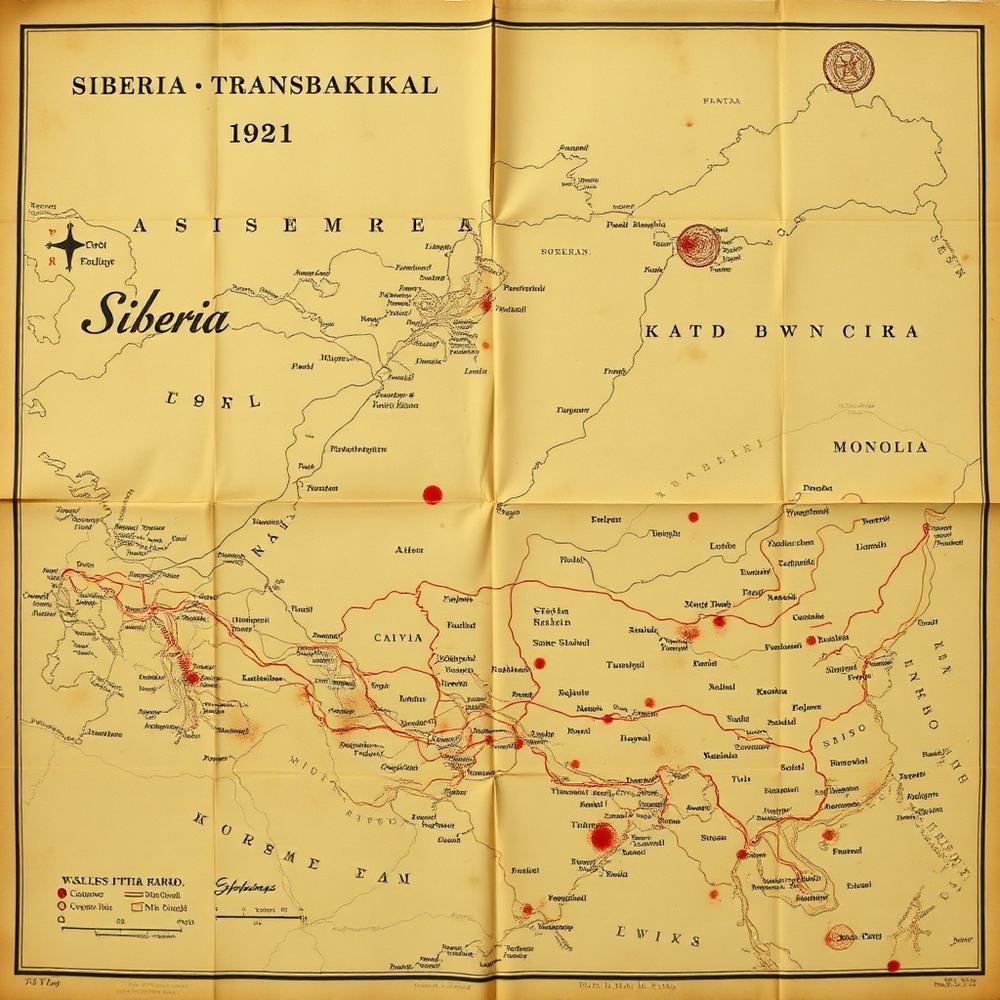
The concession's real asset was not the gravel but the paperwork. It held the licences that let refined metal leave Mongolia legally: production declarations to the Urga treasury, royalty settlements with the monastic estates, assay certificates, and consignment documents for the caravan road to Kyakhta and onward to Irkutsk banks.
That chain of documents converts anonymous metal into titled property. A bar that leaves Mongol'Or's assay office carries the company's stamp, its fineness, its serial sequence and a production declaration behind it. Nothing about that bar refers to where the gold was before it entered the smelter.
Collapse and Opportunity, 1917–1921
The revolution destroyed the concession's financial base. Russian shareholders were expropriated, Irkutsk banking became unreliable then hostile, remittances stopped, and by 1919 operations had been cut back severely. The Chinese occupation of that year added taxation and requisition on top. What survived was infrastructure without capital: sluices, a smelter, an assay office, licences, a payroll structure and an export route, all idle.
That is precisely the condition in which a concession becomes valuable to someone else. It has capacity to declare production it did not mine, and it has an urgent need for the working capital that would let it pretend otherwise.
The Zanzer Mechanism
White Khan's central historical argument runs through this company. Israel-Eli Zanzer — mining engineer, finance specialist, member of Urga's small Jewish commercial community — is the figure who joins the two halves: metal arriving from the north with no legitimate provenance, and a company with legitimate provenance and no metal.
The mechanism the novel reconstructs is deliberately unglamorous, because real laundering is: re-pour the incoming bullion to Mongol'Or's own bar standard so that no Romanov or imperial mint stamp survives; back-date and inflate recovery logs on worked-out ground so declared output plausibly matches the poured tonnage; settle royalties to the monastic estates and the Urga treasury in full, because a laundry that pays its taxes is audited last; then disburse against the declared production as payroll, remount contracts, cartridge purchases and Kyakhta trade credits — the exact categories in which a cavalry division consumes money.
The Asian Cavalry Division that stormed Urga in February 1921 was better supplied than the one that failed in November 1920. Something paid for that difference, and the concession is the only institution in the country capable of paying it without leaving a trace in any foreign bank.

Afterlife of the Ledgers
Mongol'Or's assets were nationalised after the revolutionary government consolidated power, and its records were dispersed between Ulaanbaatar and Soviet archives. The 1920–21 operating year is the gap in the run — which is either the ordinary consequence of a civil war, or the point.
Historical Sources & Further Reading
- Concession agreements between the Urga administration and Russian mining companies, 1900–1915.
- Mongol'Or company production and royalty records (surviving fragments), Mongolian National Archives.
- Irkutsk banking correspondence on Mongolian gold consignments, 1912–1919.
- Kyakhta customs registers, 1918–1921.
- C. R. Bawden, The Modern History of Mongolia — chapters on the pre-revolutionary economy.
- Russian Ministry of Trade and Industry reports on Mongolian mineral concessions.